
About
Morgan G. I. Black MA, ARSM
I am a trained, accredited singer, musician and scholar, specialising in the music of the Ancient Celts, from the European Iron Age (c. 500 BCE – 43 CE), and the Medieval Troubadours during the Anglo-French Angevin Empire of Eleonor of Aquitaine, in the South of France (1100 – 1350 CE).

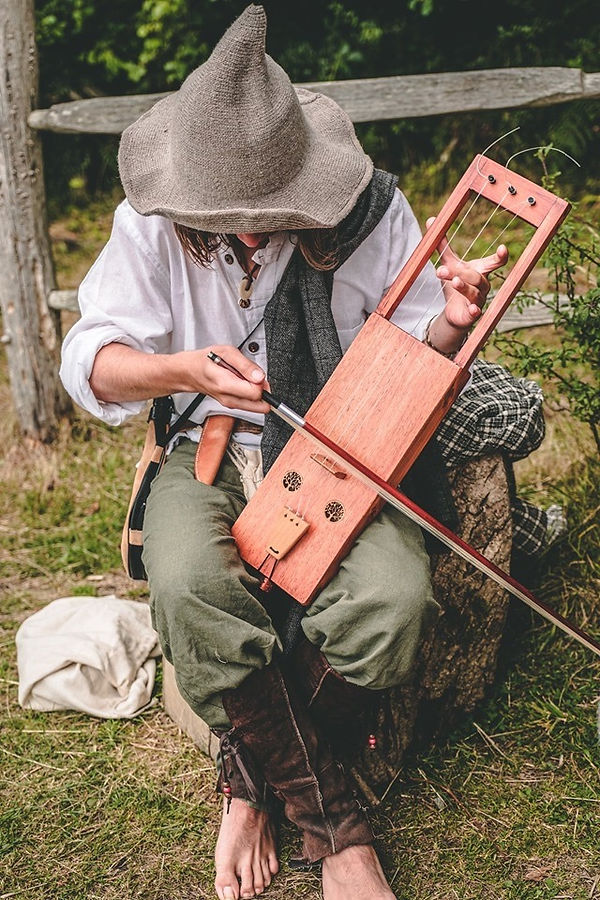
I play this instrument, the lyre, for:
Iron Age Celtic Music + Medieval Court Music
I am the first Bard to perform songs in Celtic languages to the accompaniment of the lyre since the middle ages!
I am very passionate about reviving this tradition.
It is my goal to reconstruct the music of these enigmatic, fascinating peoples, and to perform renditions of what that might have sounded like – from all the evidence available –, going back over 2000 years ago!
One of my objectives is to reintroduce the Celtic Lyre to Wales and the National Eisteddfod.
Academic Background
After growing up in the Limousin region of Nouvelle Aquitaine, France, I studied:
– Anthropology and Archaeology (BA) at
The University of Bristol
– Celtic Studies (BA) at
The University of Aberystwyth
– Celtic Studies (MA) at
The University of Wales Trinity St David, where I was awarded my certificate for my Master's Thesis entitled: Bardic Echoes: Reconstructing Ancient Celtic Music.

As a singer and musician, I am an Associate of the Royal Schools of Music (ARSM), holding a Performance Diploma for which I received a Distinction upon completion in 2017, as the highest achieving candidate for the Voice category.

About my music
I am a trained Welsh Lyric Tenor and multi-instrumentalist.
My music includes, but is not limited to:
-
The Celtic lyre (similar to a harp); the Carnyx (Celtic warhorn); the Renaissance lute and bowl-backed mandolin (among other short-necked lutes); the central Asian dombra, tar and the guitar (among other long-necked lutes); the Irish bodhrán and other frame drums (some with genuine skin) and some goblet drums; Sardinian reedpipes; panpipes and wooden flutes; various real organic horns and bone-flutes, as well as replicas; and many more!
-
Singing in Welsh (Brythonic), Irish (Gaelic), Occitan French and Ancient Greek, along with pieces from Germanic, Slavic and Native American languages and more, with translations and renditions in Modern English and French as well.
